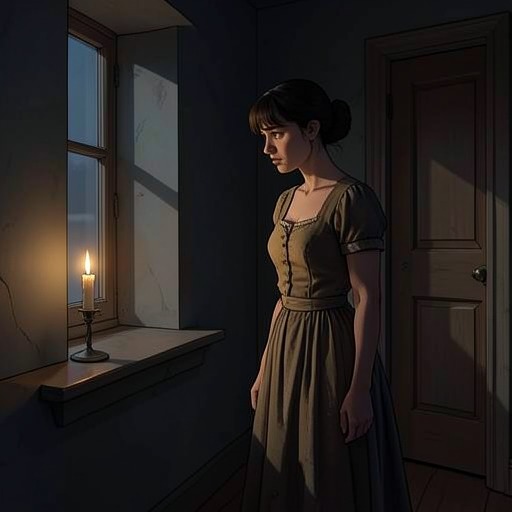
“Their only salvation is to come to me”
Handling the Undead“Their only salvation is to come to me” is a message that reaches Flora in a vision connected to Elvy Lundberg and resurfaces in Flora’s awareness as she approaches a frightened crowd. The sentence offers salvation as both certainty and demand, yet its speaker is not identified and its meaning is left open. That uncertainty matters: Flora can recognize that people need help, but neither the vision nor the words tell her what action will answer them.
The message and its first appearance
Flora hears the words after a man begins to tell her something about her grandmother. She has already been unsettled by his apparent knowledge of an experience she never shared. Meanwhile, Elvy is being cared for by the older women around her, and Flora briefly suspects that their helping hands might actually be draining the life from her grandmother. The scene therefore places the message among questions about care, vulnerability, and trust, rather than presenting it as a detached religious pronouncement.
Flora interrupts the man and goes to Elvy, laying a hand on her arm. Because they are so close to the returned dead, she experiences a sharp image in her mind: a woman on a television screen, surrounded by bright light. The message follows within that vision. The television then switches off, the image fades, and Flora is left looking into Elvy’s tired eyes. The sequence gives the words the force of an apparition, but does not establish who the woman is, whether she is speaking directly to Flora, or how the image relates to the man’s interrupted statement.
Elvy cannot explain the sentence either. She says only that she does not know what it means, but knows she has to do something. The message thus arrives as an imperative without instructions. Its promise sounds absolute, while the response it produces is hesitant and practical: Elvy feels called to act, but cannot yet say how.
A private vision in a public crowd
The sentence returns in Flora’s thoughts as she nears the gates among a crowd. In the press of other people, she cannot think logically. Her own thoughts feel sealed away, bobbing among the thoughts of those around her, and images break through without forming a coherent account. She sees a child holding a man’s hand and an older gentleman fidgeting; a rabbit flashes through the mental stream, then gives way to coffins, earth, vacant eyes, and guilt.
Within this crowded, fragmentary awareness, the same claim about salvation appears again. Its setting changes its emphasis. In the earlier scene it is attached to the bright image on a television; here it surfaces among the anxieties and associations of people moving toward the gates. Flora does not discover a clear explanation in the crowd’s thoughts. Instead, she draws a limited conclusion: people need some kind of help. The distinction between the message’s promise and Flora’s understanding remains important. The sentence names salvation, but Flora can only identify the immediate human need around her.
The crowd’s visible and felt response intensifies as Flora approaches. People grow grimmer and more determined, while trying unsuccessfully to damp down their fear. Her comparison to children entering a ghost train captures the mixture of dread and compelled forward movement without resolving what they expect to find. A woman’s question to Lennart interrupts Flora’s thought, returning the scene from its strange inward stream to the voices and bodies gathered at the gates.
Promise, responsibility, and uncertainty
The message is phrased as an exclusive promise: salvation is possible, but only by coming to an unnamed “me.” That first-person claim gives it authority while withholding the information needed to test or interpret that authority. Neither Flora nor Elvy identifies the speaker in the scenes surrounding the words. The lit woman on the television may seem to offer an image for the promise, but the narrative does not confirm that she is its source or explain what it means to come to her.
This gap between a sweeping promise and uncertain knowledge shapes the phrase’s force. Elvy takes from it a sense of obligation, not a plan; Flora takes from its return the recognition that people need help, not a revelation about how to provide it. In both cases, the words press toward action before they can be made logically clear. The message therefore works less as an explanation than as a burden: someone appears to be calling for a response, but those who hear it do not know what response would count as salvation.
Recurrence amid danger
Later, Flora is caught in a courtyard crisis as men confront a heap of still-quivering bodies. An old woman bites one man’s arm and hangs from it even as he tries to pull away. His friend attempts to respond to the injury, but the injured man instead splashes liquid over the bodies and runs around the heap. Flora’s paralysis begins to lift as she recognizes another figure: herself, moving toward the lamppost and the men preparing to take matches from a backpack.
This courtyard episode does not repeat the sentence, and it supplies no explanation of the earlier vision. Its relevance lies in the sharp difference between salvation as a promise and help amid immediate violence. At the gates, Flora can feel that the crowd needs help; in the courtyard, she faces a scene in which fear, injury, and threatened violence leave little room for certainty. The phrase’s unresolved call consequently persists as a question of response rather than a solved prophecy: the message promises rescue, but the scenes around it show how difficult it is to know what rescue requires.